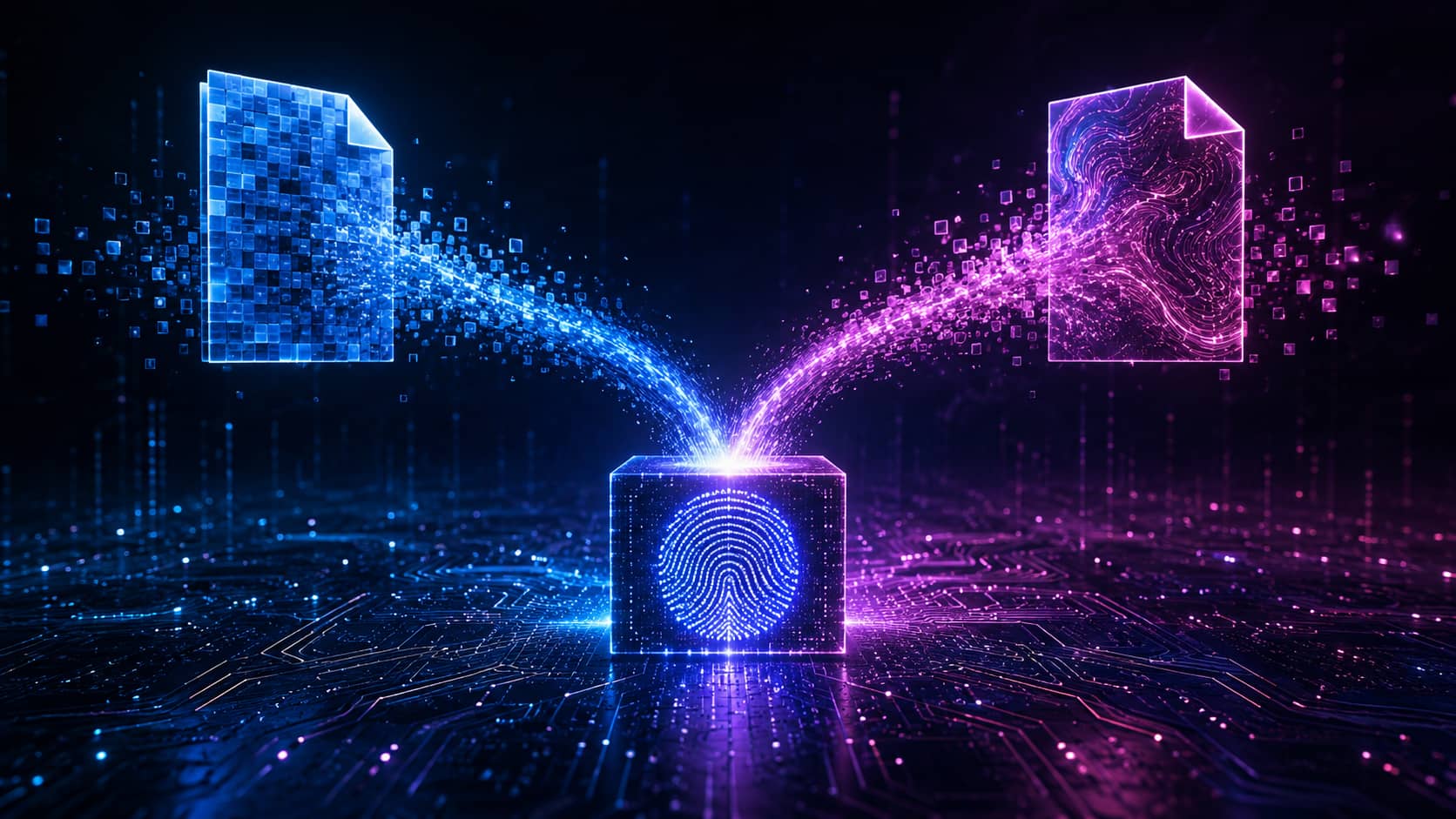
Yes. Two different files can have the same MD5 hash. This is called a collision. Because MD5 returns only 128 bits while the number of possible files is unlimited, collisions must exist mathematically. More importantly, researchers can deliberately construct MD5 collisions, which makes MD5 unsuitable when a matching digest is supposed to prove that content is trustworthy.
Accidental and deliberate matches are different
An accidental collision between ordinary unrelated files is still unlikely in a small collection. A deliberate collision is created by an attacker using weaknesses in MD5’s design. Security must consider the deliberate case whenever someone can influence the files.
This is why “we have never seen a collision” does not validate a security design. Your normal files were not generated by a cryptanalyst trying to exploit the hash.
What identical MD5 values really tell you
If two files have the same MD5 value, one of several things may be true: the files are byte-for-byte identical, an accidental collision occurred, a collision was engineered, or the comparison process is wrong. MD5 alone cannot distinguish these possibilities.
For files created inside a trusted workflow, a match is often a convenient duplicate hint. Confirm byte equality before deleting or overwriting data. For downloaded software, signed documents, certificates, or adversarial content, use SHA-256 or another current hash and verify authenticity through a digital signature or trusted metadata.
How collision demonstrations work
Early MD5 collision demonstrations often created pairs with carefully controlled binary differences. Later chosen-prefix techniques allowed researchers to start from different prefixes and append calculated blocks that lead to the same digest. The visible files can therefore carry different initial content while sharing an MD5 result.
The HashClash research project documents collision-generation work for MD5 and SHA-1. These results are the reason security guidance treats MD5 collision resistance as broken, not merely old-fashioned.
Does a collision reveal the original file?
No. Finding two colliding files is different from taking a specific MD5 hash and recovering the exact original input. The latter is a preimage problem. MD5 collision attacks do not provide a universal “decrypt MD5” operation.
Attackers recovering weak passwords from MD5 usually guess likely passwords and compare their hashes. That attack succeeds because human passwords are predictable and MD5 is fast, not because the digest contains a decryptable copy.
Why file format matters
Useful collision attacks must produce files that remain valid and meaningful after special collision blocks are inserted. Flexible formats, ignored sections, comments, and multiple data streams may give attackers places to hide controlled bytes. A raw collision in arbitrary binary data is not automatically an exploit against every format.
Defenders should not rely on a format being awkward to manipulate. When the integrity design needs collision resistance, use an algorithm intended to provide it and an authenticated release process.
Can SHA-256 files collide too?
Collisions also exist for SHA-256 in the mathematical sense, because its output is finite. However, no practical method is known for finding collisions in full SHA-256. A generic attack would require work on the order of 2 to the power of 128 evaluations, far beyond practical capability.
This difference between “collisions exist” and “collisions can be found” is central to cryptography. A secure hash makes the second statement infeasible under current knowledge and resources.
What about very large file collections?
As the number of hashed objects grows, random collision probability rises according to the birthday effect. With a 128-bit ideal hash, the theoretical halfway point is around 2 to the power of 64 objects. MD5’s structural weaknesses are a more immediate security concern than reaching that random scale.
Systems sometimes truncate hashes to save space. That changes the calculation dramatically. Keeping only 32 bits means collisions become likely around tens of thousands of objects. Store full digests for identity and integrity decisions.
Safe duplicate detection
- Use file size as a quick first filter.
- Calculate SHA-256 for files with matching sizes.
- If deletion or replacement has high impact, perform a byte-for-byte comparison.
- Handle read errors and files changing during the scan.
- Record the algorithm and full digest rather than an unlabeled shortened value.
MD5 may be faster in some environments, but modern SHA-256 implementations are widely optimized. Measure before accepting weaker collision behavior as a performance necessity.
Safe download verification
Obtain a SHA-256 checksum from the publisher’s official channel and calculate it locally. Follow the commands in the Windows, macOS, and Linux checksum guide. When the publisher offers a digital signature, verify that too. A checksum copied from the same compromised mirror as the file does not establish authenticity.
The answer in practical terms
Different files can share an MD5 hash, and attackers can create such pairs intentionally. Use MD5 only where it acts as a non-security legacy identifier and a collision would be harmless. For new integrity work, choose SHA-256 or another current algorithm. For trust in who produced a file, add a digital signature. A digest is one signal in a verification process, not a complete proof by itself.