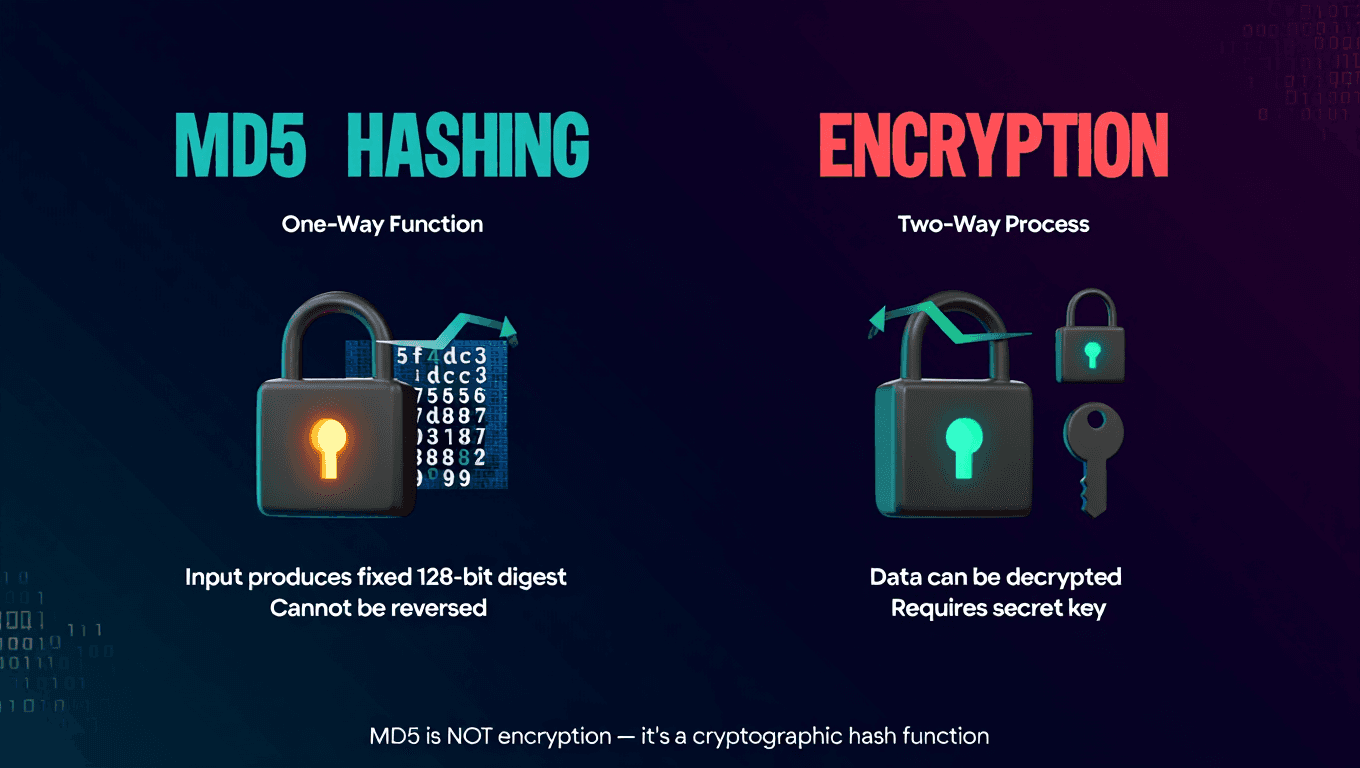
The short answer is no: MD5 cannot be decrypted in the normal meaning of the word. This question appears often because many websites use phrases like MD5 decrypt, reverse MD5, or MD5 decoder. Those tools may sometimes find the original text, but they are not decrypting the hash. They are usually performing a lookup against known values or testing likely guesses until one produces the same hash.
MD5 is a one-way hash function. It takes input and produces a fixed 128-bit digest, as described in RFC 1321. The process is deterministic, so the same input gives the same output every time. But the algorithm is not designed to keep a reversible path back to the input. That is the central difference between hashing and encryption, which we explained in MD5 Encryption vs Hashing.
So why do online reverse MD5 tools sometimes work? They work when the original input is already known, common, short, or guessed. For example, if a tool has a database containing the MD5 hash of password123, it can show password123 when you paste the matching hash. Nothing was decrypted. The service simply recognized a value it had seen before.
Attackers use a similar idea when they test password lists. They take a candidate password, calculate its hash, then compare it with the target hash. If the values match, the candidate was correct. This is why common passwords are weak even when hashed. A fast hash such as MD5 lets an attacker test guesses at high speed, which is one reason MD5 is not suitable for password storage.
A strong random input is a different story. If the original value is long, random, and not present in a lookup database, reversing the hash is not practical by normal means. But relying on that fact for passwords is still bad design. Real users choose patterns, reuse passwords, and create predictable strings. A secure password storage system should assume attackers will run offline guesses if the database leaks.
Modern password guidance focuses on slow, salted, adaptive hashing. OWASP recommends algorithms such as Argon2id, scrypt, bcrypt, and PBKDF2 depending on the environment. A salt ensures that two users with the same password do not have the same stored hash, and the work factor slows down each guess. MD5 does not provide those protections by itself.
There is also a separate issue: MD5 has collision weaknesses. A collision is not the same as reversing a hash, but it is another reason MD5 should not be used for digital signatures, certificates, or other security-sensitive integrity checks. RFC 6151 updates the security considerations and is a useful reference for readers who want the official background.
The practical takeaway is simple. If you are trying to recover your own forgotten password from an MD5 hash, there may be no reliable way unless the original was weak or known. If you are building software, do not design systems that require MD5 recovery. Use hashing for comparison, encryption for data that must be read again, and modern password hashing for login credentials.